MOUSE logo

Open-source nuclear microreactor economics

MOUSE: Bridging Microreactor Design and Economics

MOUSE (Microreactor Optimization Using Simulation and Economics) is a framework connecting early-stage microreactor design choices to bottom-up technoeconomic outcomes. By coupling physics-based core simulations with detailed cost estimation, it helps engineers, investors, and policy makers see how geometry, fuel, enrichment, and operating assumptions drive capital cost and LCOE before major decisions are locked in.

Motivation

Microreactors need economics in the design loop.

Nuclear microreactors are being developed for transportable, rapidly deployable, resilient power in remote or infrastructure-limited locations. Their small size and modularity can also amplify diseconomies of scale: first-of-a-kind costs may be driven by fuel fabrication, specialty materials, indirect costs, and other accounts that do not shrink proportionally with power.

Economics cannot wait

Historically, reactor development has treated physics and engineering as the primary design drivers, with economics arriving later. For microreactors, that sequencing is risky because fuel loading mass, enrichment, core geometry, materials, and balance-of-plant complexity can be largely fixed by the end of core design.

Tradeoffs made visible

MOUSE makes economics a first-class input to design by building costs from first principles rather than scaling down large reactor estimates. It helps teams test whether choices such as exotic fuel forms, reflector changes, longer fuel lifetime, or material substitutions actually improve levelized cost of electricity.

What MOUSE Does

One workflow for microreactor design and economic screening.

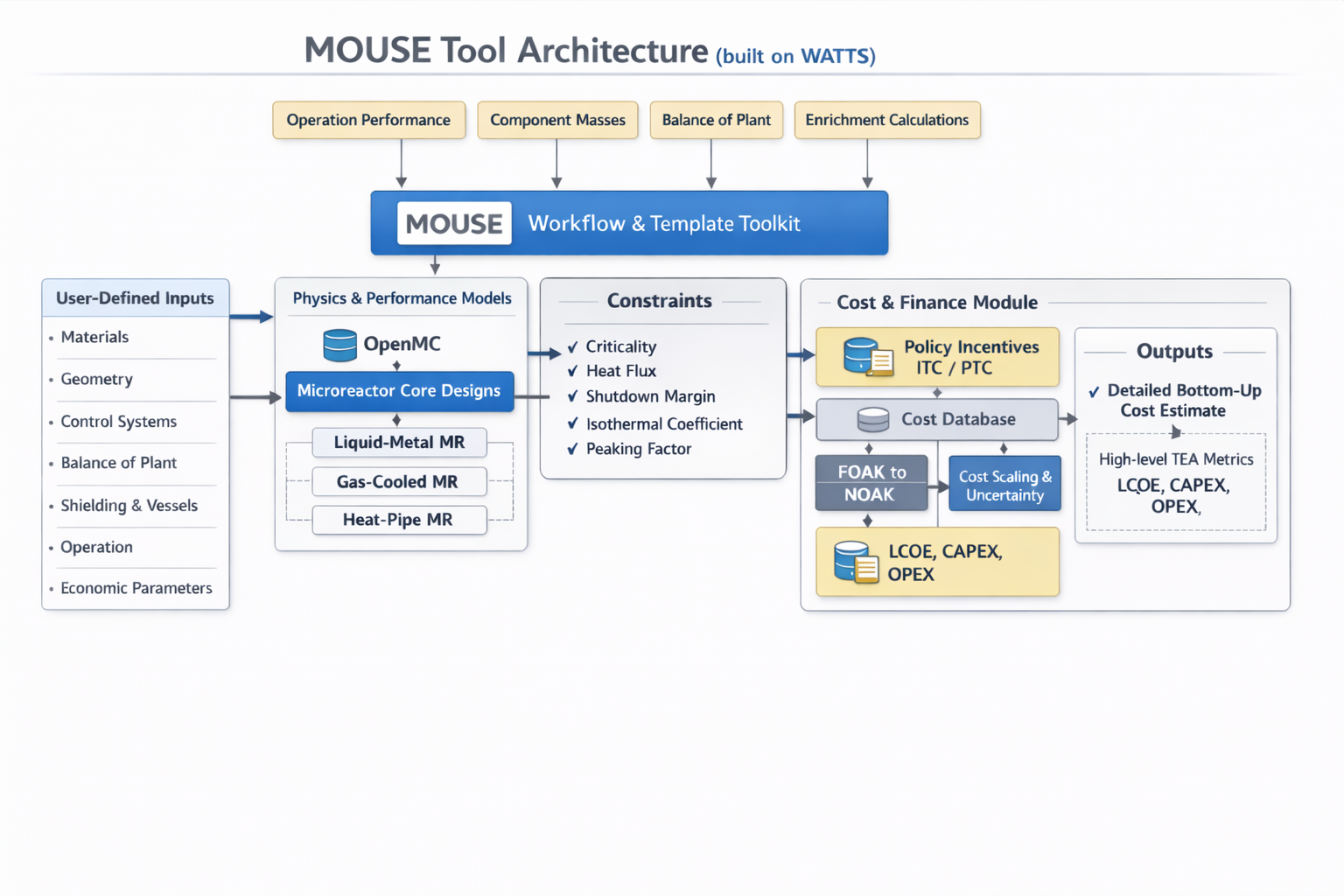
MOUSE integrates OpenMC Monte Carlo neutron transport, simplified balance-of-plant calculations, and a bottom-up cost engine built from MARVEL project data and open literature. It produces FOAK and NOAK projections for liquid-metal thermal, gas-cooled, and heat-pipe microreactor concepts, connecting design choices to cost, fuel cycle, neutronics, thermal, and transportability outcomes.

Technical and cost outputs

Estimate overnight capital cost, total capital investment, LCOE, levelized cost of heat, fuel lifetime, burnup, enrichment needs, and first-order thermal hydraulic sizing.

Reference reactor concepts

Compare LTMR, GCMR, and HPMR designs while checking geometry, materials, fuel enrichment, financing assumptions, IRA credits, market conditions, and transport limits for truck, rail, and sea containers.

Repository and web app

Run custom OpenMC and WATTS workflows in Python for parametric studies, sensitivities, and uncertainty propagation, or use the Streamlit app's precomputed nearest-neighbor results for second-scale estimates.

GitHub Repository

Full-control analysis from reactor inputs to cost and market context.

The MOUSE Python package is published by the Idaho National Laboratory GitHub organization for users who need full control over their analysis. It exposes the complete OpenMC Monte Carlo neutron transport workflow, WATTS-powered parametric and sensitivity studies, custom geometry and materials, modifiable balance-of-plant assumptions, and the full bottom-up cost engine.

  • Introduce new reactor types or modify LTMR, GCMR, and HPMR reference designs.
  • Run uncertainty propagation and inspect raw FOAK and NOAK cost breakdowns.
  • Trace every capital, fuel cycle, financing, operations and maintenance, replacement, and decommissioning account.
  • Estimate OCC, TCI, annualized cost, LCOE, LCOH, fuel cycle metrics, transportability, and market competitiveness.
  • Review full Code of Accounts breakdowns, cost-driver rankings, and benchmark comparisons.
MOUSE workflow diagram connecting microreactor design, cost estimation, and economics
MOUSE links reactor design inputs, engineering calculations, cost estimation, uncertainty, and market benchmarks into one transparent scoping workflow.

Physics and design control

Define custom geometries, materials, reactor types, enrichment levels, core layouts, and balance-of-plant assumptions for deeper studies than the curated web app exposes.

Line-item economics

Access bottom-up cost accounts for capital, fuel cycle, financing, operations and maintenance, replacements, decommissioning, FOAK learning, and NOAK deployment cases.

Workflow analysis

Connect reactor design, balance-of-plant sizing, uncertainty ranges, Code of Accounts results, cost-driver rankings, LCOE, LCOH, and market benchmarks in one reproducible workflow.

Design tradeoff examples from the repository

These studies show why coupling physics and economics matters: choices that extend fuel lifetime or shrink the core can still lose economically once material cost, fuel loading, and deployment assumptions are included.

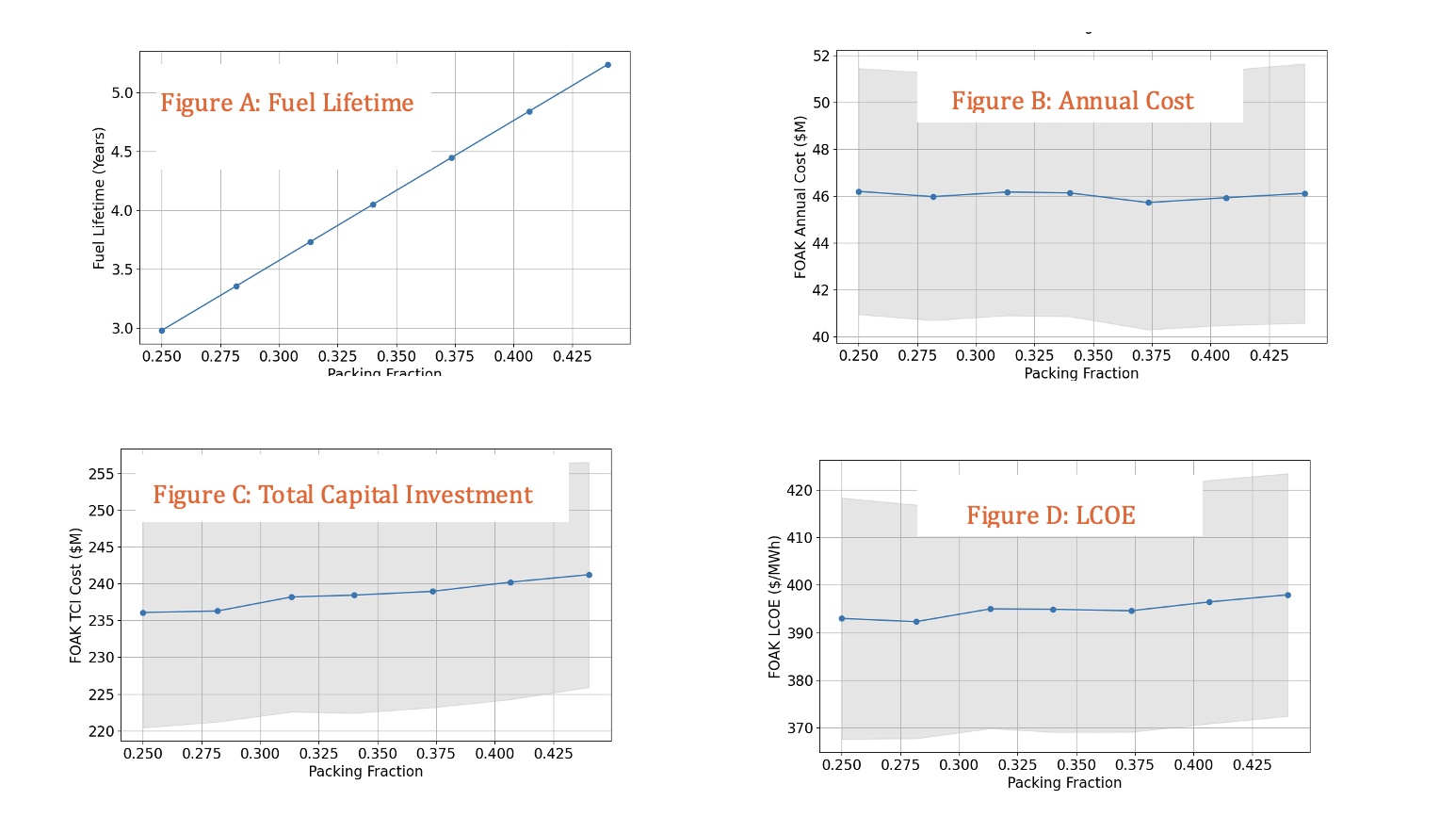
Packing fraction sensitivity plots showing fuel lifetime, annual cost, total capital investment, and LCOE for a TRISO-fueled microreactor
Increasing TRISO packing fraction extends lifetime, but not necessarily value. Higher packing fraction increases fuel lifetime by more than 40%, while annual cost stays nearly flat and total capital investment rises slightly. The result is a small increase in FOAK LCOE, revealing a tradeoff that lifetime alone would miss.
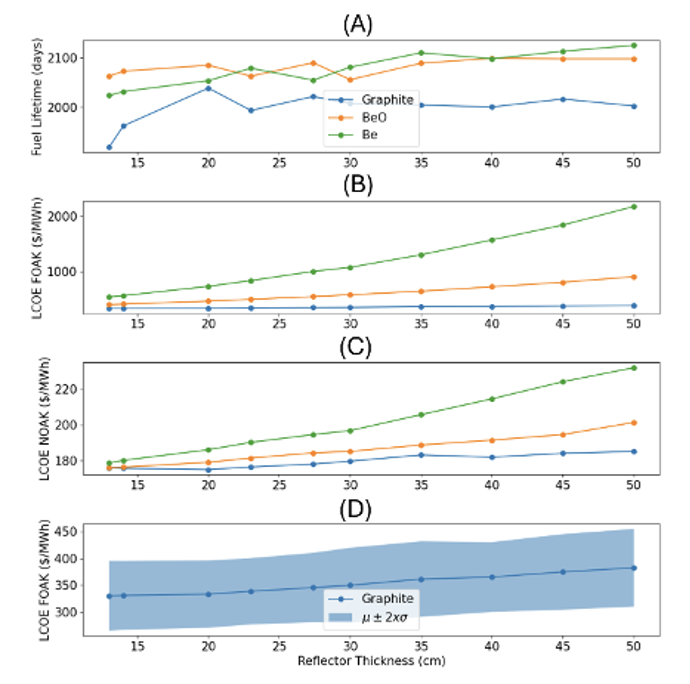
Reflector material and thickness tradeoff plots comparing graphite, beryllium oxide, and beryllium for fuel lifetime, FOAK LCOE, and NOAK LCOE
Reflector choice is a coupled design-economics problem. Be and BeO can improve neutron economy, reduce size, and extend fuel lifetime, but graphite often wins economically because its unit cost is much lower. Be-based reflectors may still matter when transportability or compactness is the binding constraint.

Streamlit App

A web-based scoping tool for rapid technical and economic screening.

The hosted app makes MOUSE accessible to engineers, investors, and policy makers without any simulation environment or code setup. Instead of running full Monte Carlo and depletion calculations at runtime, it serves precomputed parametric results through fast nearest-neighbor interpolation, returning updated cost estimates within seconds as users adjust inputs for LTMR, GCMR, and HPMR designs. The app organizes results into design and cost summaries, transportability checks, scoping metrics, cost decomposition, and market and geographic competitiveness views for scoping, comparison, and stakeholder communication.

Reactor Types LTMR · GCMR · HPMR Liquid metal · gas cooled · heat pipe
Costs OCC · TCI · LCOE · LCOH · LCOF Bottom-up estimation · cost drivers · IRA credits
Neutronics & Thermal Hydraulics Peaking factor · leakage · power density · coolant inventory First-order scoping
Fuel Cycle U-235 / U-238 mass · lifetime · discharge burnup
Transportability Component dimensions · mass · truck · rail · sea First-order scoping
Costs in Perspective NOAK LCOE vs. market benchmarks Wholesale and retail electricity price comparisons

Reactor Concepts

Reference models for three microreactor concepts.

The repository includes reference models for liquid-metal, gas-cooled, and heat-pipe microreactor concepts. These are pre-conceptual designs intended for transparent technoeconomic assessment.

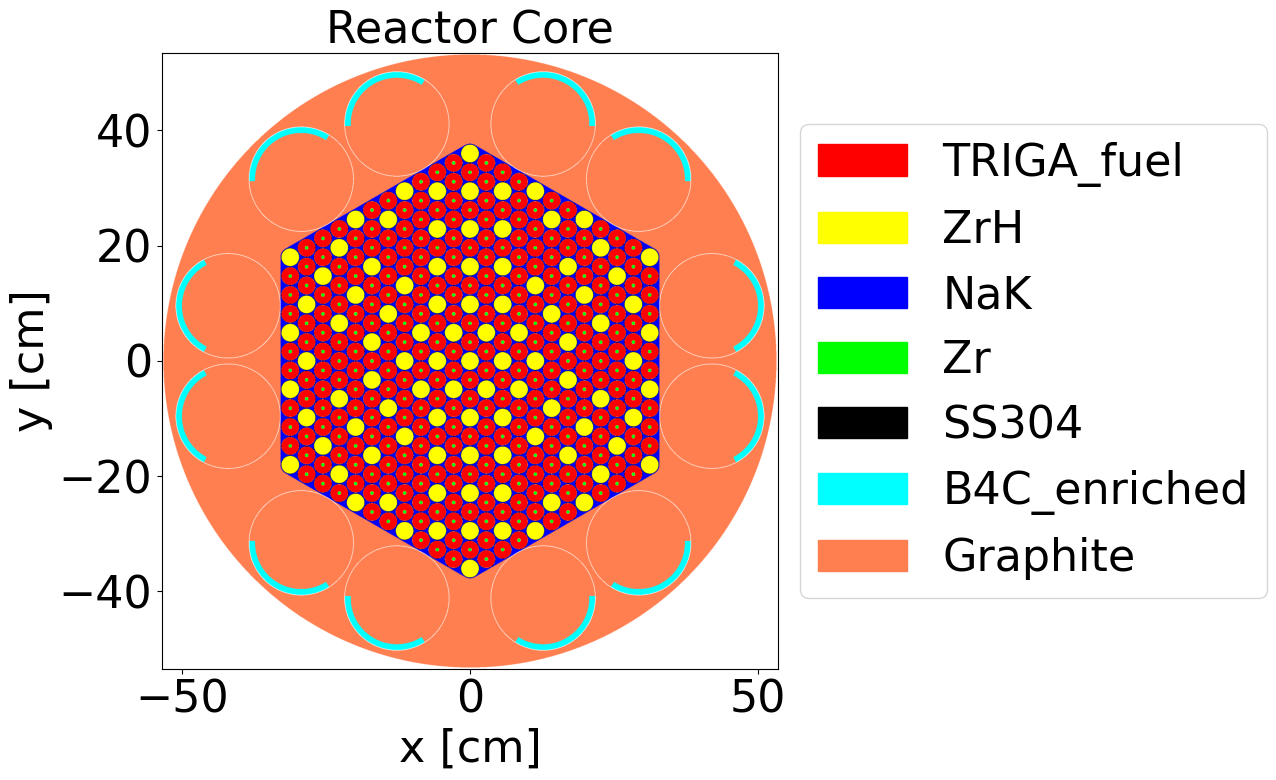
Liquid-metal thermal microreactor core model

LTMR

Liquid-metal thermal microreactor reference concept.

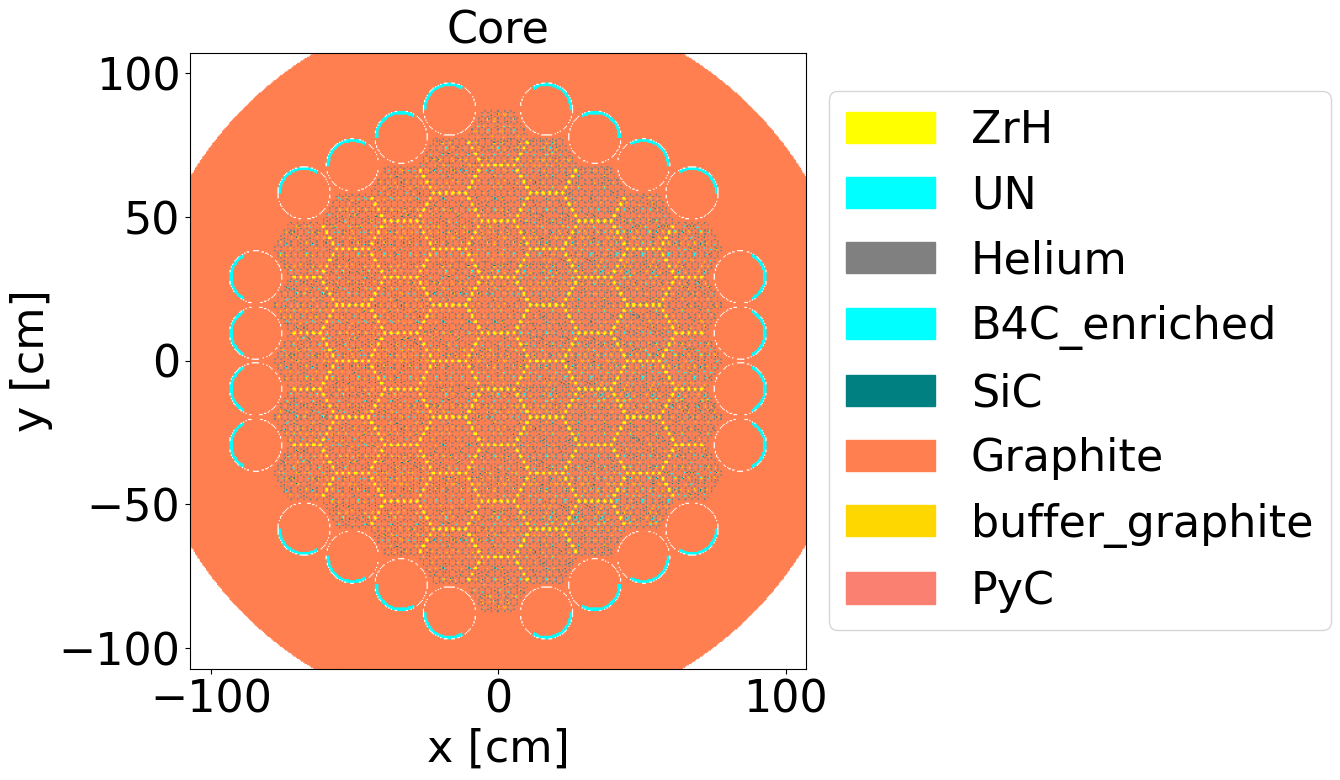
Gas-cooled TRISO-fueled microreactor core model

GCMR

Gas-cooled TRISO-fueled microreactor reference concept.

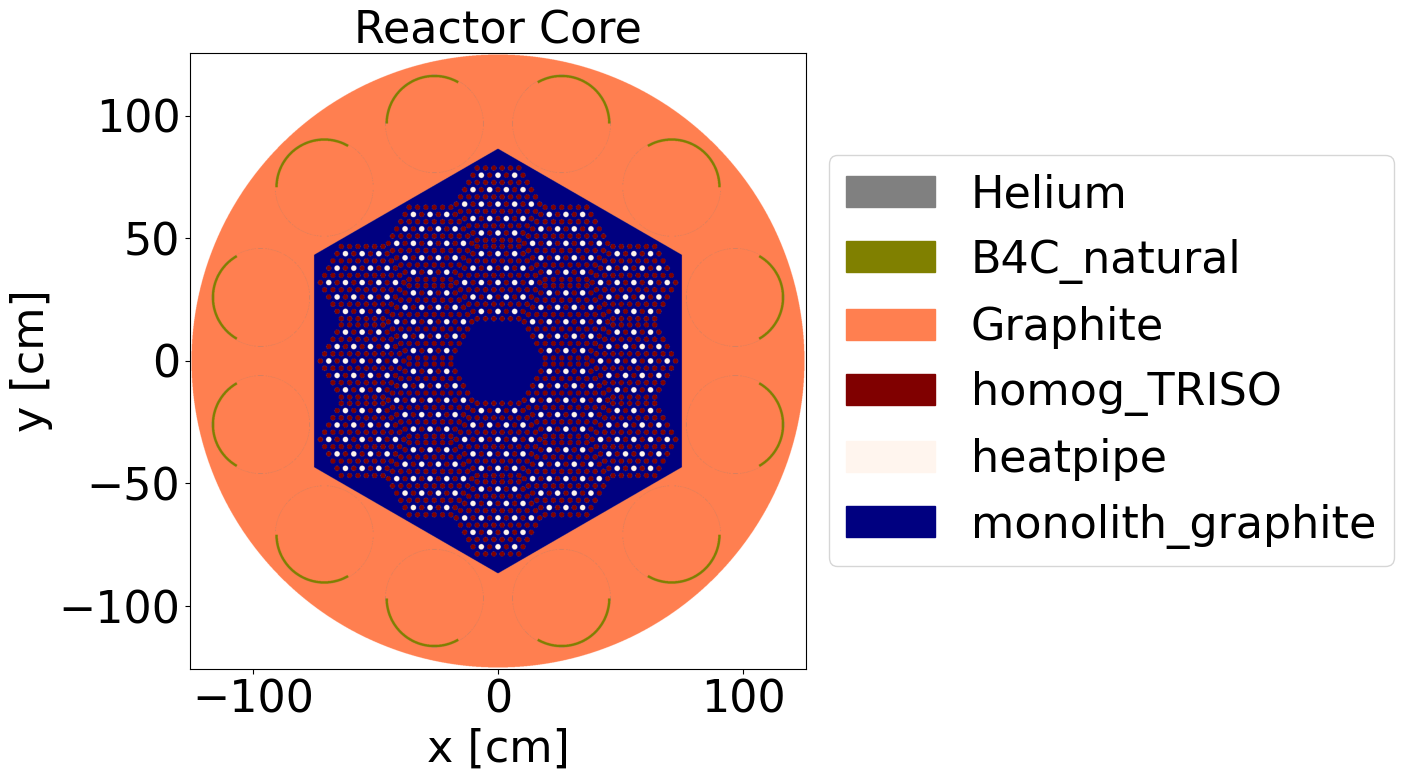
Heat-pipe microreactor core model

HPMR

Heat-pipe microreactor reference concept.

Explore microreactor costs interactively.

Launch the hosted app to compare reactor inputs, uncertainty ranges, FOAK and NOAK costs, LCOE, fuel cycle metrics, and cost drivers.